
As a DELE examiner and during my DELE A2 preparation courses, I sometimes feel “atrapada en el tiempo” as in “el día de la marmota” (Groundhog day) as I repeat the same kinds of corrections over, and over, and over again.

So today, I thought I’d share with you the most common mistakes for English speakers when preparing for the DELE A2 oral and written tasks. I’ve included my top 5, as well as some techniques than can help you improve them. Ready? ¡Vamos!
1. Gender and number
Although gender and number agreement are probably one of the first things you study, I can safely bet one of the first mistakes you’ll make in the speaking test will be something along the lines of:
“Lleva unas chaqueta negro” instead of Lleva una chaqueta negra (s/he wears a black jacket).
Though not a crucial mistake (it doesn’t impede communication), it will make your examiner cringe a little bit, and it’s generally a lapsus (so a mistake you can avoid if you’re vigilant).
How to fix it:
- Learn the gender of new vocabulary words as you study and try to match an adjective to each noun with the correct gender so your brain gets used to the structure. If you are a visual learner, highlighting the clothes vocabulary with pink and blue markers can help.

2. Ser and estar
This is probably one of those mistakes that, if you’re not vigilant, will become a fosilized mistake, meaning you will carry it with you for.. well, forever, if you don’t do anything about it!
“Ella está muy seria y trabajadora” instead of Ella es muy seria y trabajadora (she is serious and hardworking).
How to fix it:
- Memorize structures you will often be using with concrete examples about your day-to-day life. For example: Soy profesora, soy muy curiosa, soy un poco tímida, no soy muy estricta. Estoy en casa, estoy contenta, y hoy estoy un poco cansada.
3. Overusing pronouns
In Spanish, subject pronouns (like yo, tú, él…) are often dropped because the verb endings indicate the subject. English speakers sometimes overuse them.
“Yo hablo español todos los días” instead of “Hablo español todos los días” (I speak Spanish every day).
How to fix it:
- Listen carefully to native speakers and notice how they omit pronouns, and try to imitate them by copying full fraes. Remember, the verb conjugation usually tells you the subject!
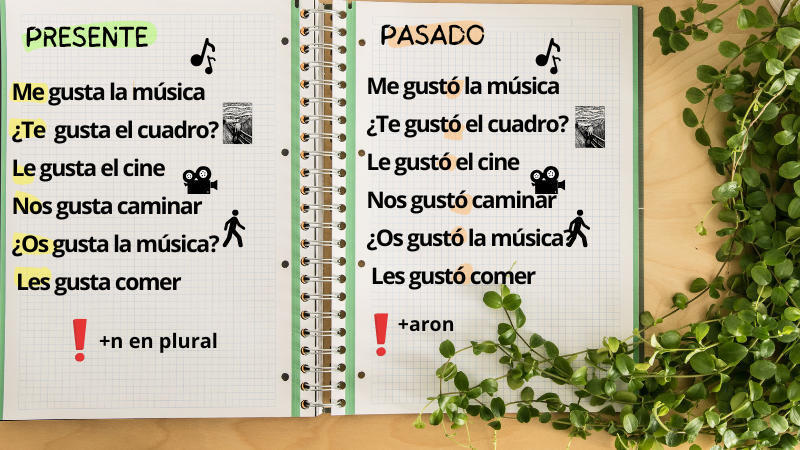
4. The verb gustar
- “Yo mi gusto los viajes” instead of “Me gustan los viajes” (I like trips)
How to fix it:
- Memorize this verb in the present and the past and practice with real examples in context to be able to use it effortlessly.
5. Por and para
Although prepositions are generally more advanced and require a great effort in learning as they often have no “logical” origin (neither does gender, you might argue!), it is true that “por” and “para” are used ALL of the time, and generally, wrongly!
“Gracias para la ayuda” instead of “Gracias por tu mensaje” (Thanks for your message)
How to fix it:
- Take time reviewing in which cases we use each of them and try to memorize some simple sentences using them.
How about you? Have you struggled with these mistakes too? Do you have any other recurring problems? Let me know in the comments!


